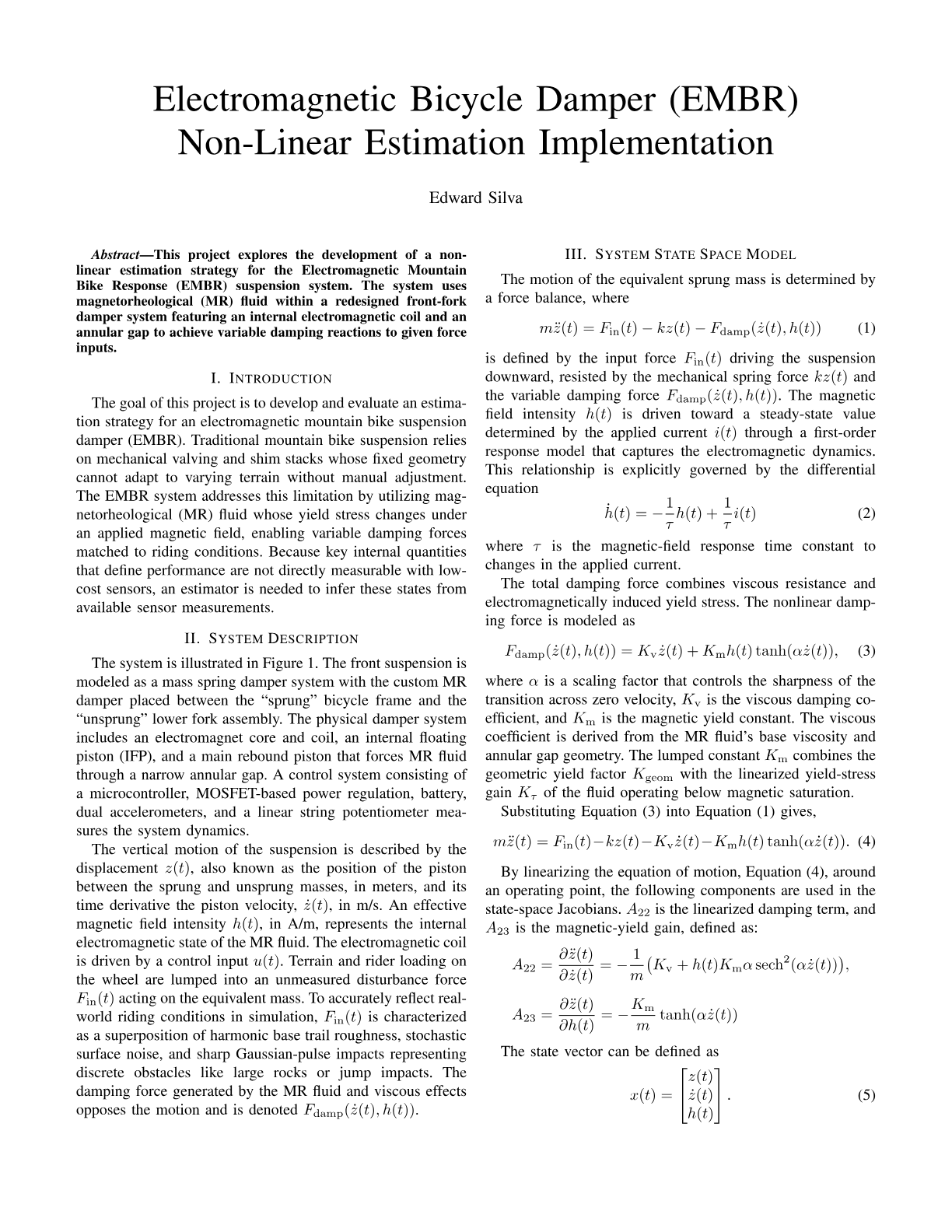
Non-Linear State Estimation for the EMBR Damper
Spring 2026EENG 519
Designed and compared Extended and Unscented Kalman Filters in MATLAB and Simulink to estimate unmeasured states of the EMBR damper, including terrain load, with the UKF providing tighter error bounds
Details
- Developed a non-linear state estimation strategy for the EMBR suspension system entirely in MATLAB and Simulink, modeling the custom MR-fluid damper with its internal electromagnetic coil and annular gap alongside a simulated sensor suite of dual accelerometers and a string potentiometer
- Formulated continuous and discrete-time non-linear state-space representations of the damper dynamics, modeling real-world disturbance forces as a superposition of harmonic trail roughness, stochastic surface noise, and sharp Gaussian-pulse discrete obstacle impacts
- Augmented the state vector with unmeasured terrain force modeled as a discrete random walk, letting the filters estimate rider and terrain loading directly alongside displacement, velocity, and magnetic field intensity rather than treating it purely as process noise
- Designed and implemented Extended (EKF) and Unscented (UKF) Kalman Filters to infer unmeasured internal states, demonstrating that the UKF provided tighter error bounds by using the unscented transform to eliminate the analytical linearization errors inherent to the highly non-linear fluid yield transition
- Simulated a gain-scheduled coil current stepping from a 1 A trail-chatter baseline to 2 A when obstacle forces exceed 750 N, stiffening the damper through large impacts while every estimated state held within its theoretical 3-sigma covariance bounds across the full run
- Tuned a 9-sigma-point unscented transform over the 4-dimensional augmented state, removing the first-order Jacobian errors the EKF exhibits during tanh-shaped fluid yield transitions at velocity zero-crossings, and identified real-time embedded deployment of the UKF as the follow-on step