Gantry Crane Control System
Fall 2025EENG 417
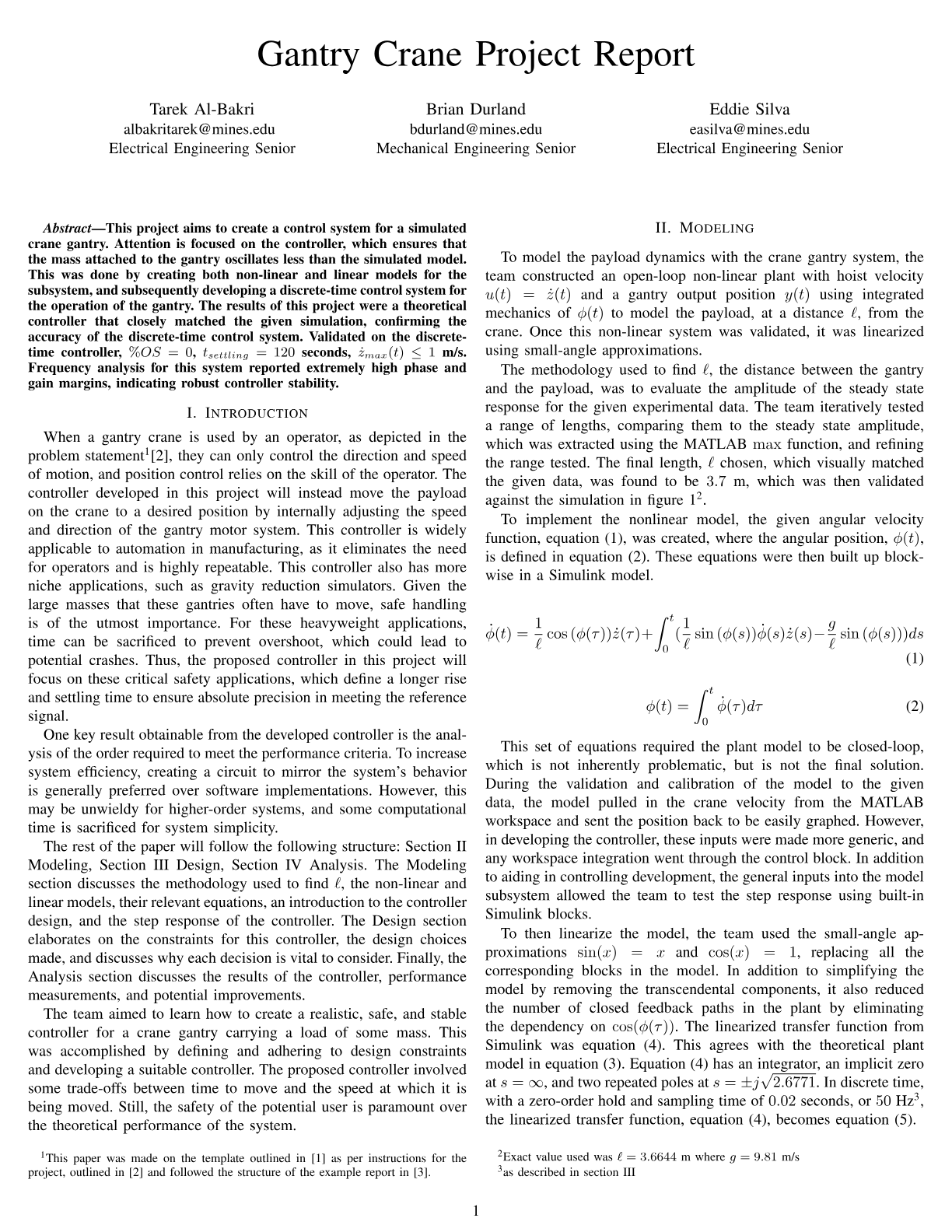
Designed a 50 Hz discrete-time gantry crane controller in the z-domain, reaching a 48-degree phase margin with zero overshoot and under 1 degree of payload swing
Details
- Identified the effective 3.7 m cable length by iteratively fitting the model's steady-state oscillation amplitude to experimental crane data, then built and validated both nonlinear and small-angle-linearized Simulink models against the same measured response
- Designed a 50 Hz discrete-time controller directly in the z-domain, shaping the loop with a near-symmetric zero pair around z = 1 to achieve a 48 degree phase margin, zero overshoot on a 1 m position command, and payload swing under 1 degree (about 3 inches at the 3.7 m cable length), all within the 1 m/s cart-speed safety limit
- Confirmed robustness by translating the phase margin into a predicted 0.5 s (25-sample) delay tolerance, then injecting that transport delay in simulation and observing the onset of marginal instability exactly as predicted
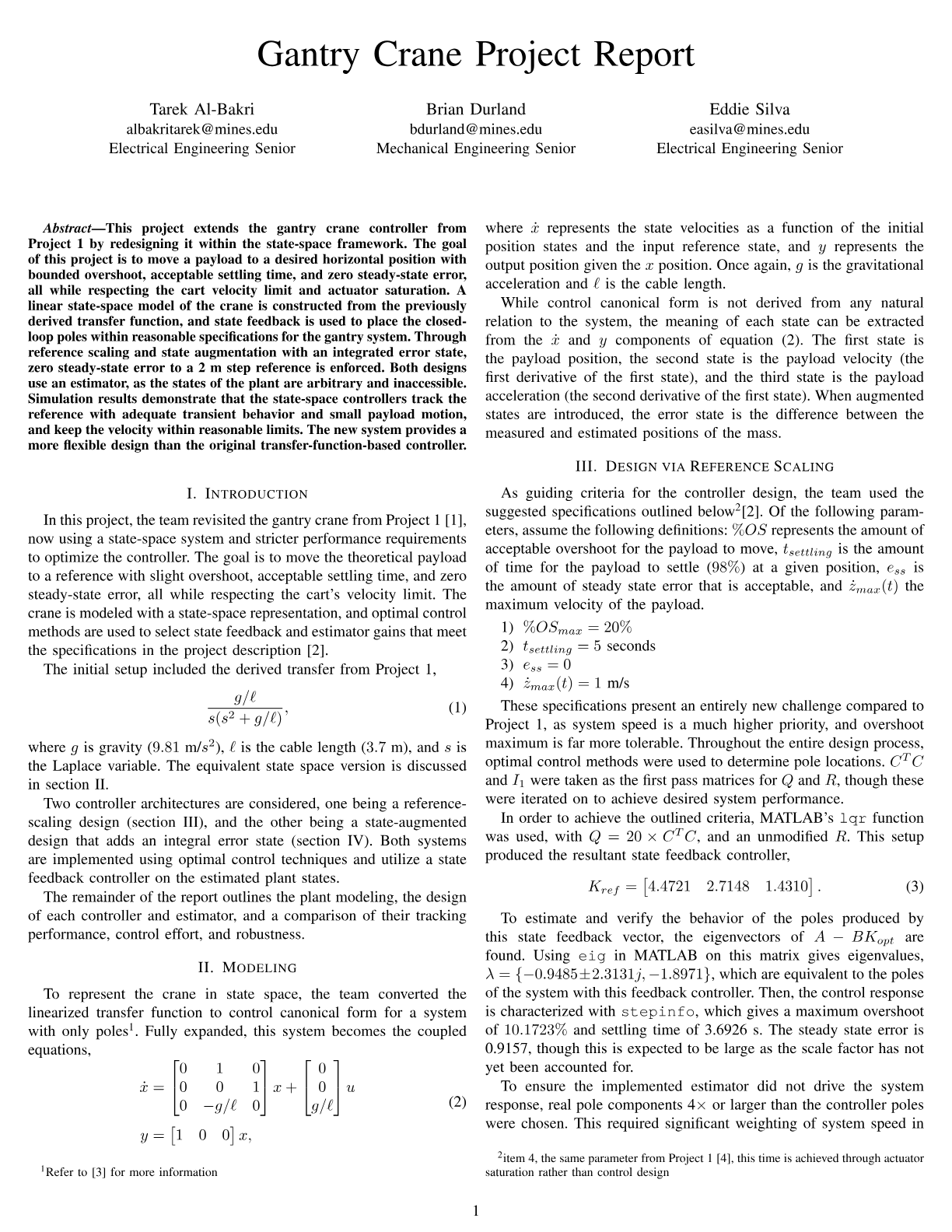
- Reframed the problem in state space and compared two observer-based LQR strategies, one using reference scaling (N = 4.47) and one augmenting an integral error state; both achieved near-zero steady-state error under actuator saturation, with the augmented design settling fastest at about 3.4 s with essentially zero overshoot
- Placed estimator poles roughly 6x faster than the controller poles so observer dynamics never drove the response, and added back-calculation anti-windup to the integral-augmented design to keep the saturated actuator from degrading settling time
- Quantified the robustness cost of the faster augmented design through loop-gain analysis, measuring gain and phase margins of 2.0 dB and 24 degrees versus 3.2 dB and 37 degrees for the reference-scaling design, and flagged margin validation as a prerequisite for any physical implementation